
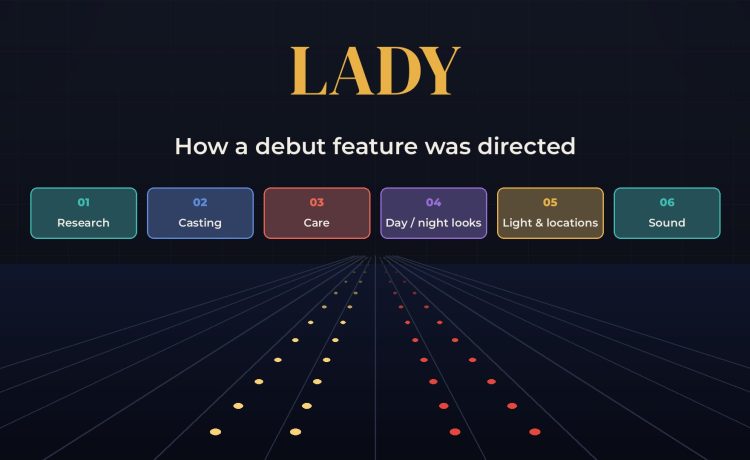
Olive Nwosu won Best Director at AFRIFF 2026 for LADY, her first feature. Who she is, how the film was made, and what filmmakers can learn from it.
LADY is set and shot in Lagos, much of it at night and on real roads, with a mostly new cast. It premiered at Sundance in January 2026 and has spent the year on the festival circuit. In November it opened the 15th Africa International Film Festival (AFRIFF) in Lagos and came away with the directing prize. This guide pulls together what Nwosu has said in published interviews about her process, so you can come back to it as a reference.
Prefer to watch? The companion video on The Hidden Ledger walks through each of these decisions with original diagrams:
Watch on YouTube: How Do You Direct a First Feature in Lagos at Night? Olive Nwosu’s LADY
The AFRIFF 2026 Best Director win
AFRIFF’s 15th edition ran in Lagos from 1 to 7 November 2026 and closed with its Globe Awards on 7 November. Afrocritik’s list of winners names Olive Nwosu as Best Director for LADY. What Kept Me Up’s festival recap reports the same result. Best Feature Film went to Slum Bomber, the Ugandan boxing drama directed by Maureen Jolly Nankya.
A note on sourcing: when we checked on 20 November, the festival’s own website was still showing the previous edition’s winners. So this article attributes the result to those two Nigerian film outlets, which published it on 10 November.
Who is Olive Nwosu?
Nwosu was born and raised in Lagos and lived in Nigeria for the first 17 years of her life. She now lives in London. She trained in filmmaking at Columbia University in New York and also holds a master’s degree in psychology. She has said that this second qualification shaped both what LADY is about and the way it was made.
Her short films had already travelled before LADY:
- Troublemaker (2019): a student film set in eastern Nigeria and cast entirely with non-actors. It screened at the Clermont-Ferrand International Short Film Festival and is described as the first Igbo-language film on the Criterion Channel.
- Egúngún (Masquerade) (2021): her Columbia graduation short. It premiered at the Toronto International Film Festival and then screened at Sundance.
What is LADY about?
Lady, played by Jessica Gabriel’s Ujah, is one of very few women driving a cab in Lagos. She is saving her earnings so that she can leave the city. Then her childhood friend Pinky (Amanda Oruh), now a sex worker, comes back into her life, and Lady starts driving a group of women through the city’s nightlife. Nigeria’s removal of fuel subsidies sits in the background. The dialogue is in Nigerian Pidgin and English, and the film runs 93 minutes, according to the Sundance festival listing.
Nwosu named the character after Fela Kuti’s song “Lady”. She told Afrocritik she wanted to celebrate the character “for all her complexity and her agency and her strength and her power”.
Who made it: development, finance and production
According to Deadline’s Sundance interview, Nwosu developed LADY at Film4 and with the Sundance Institute’s lab. The film was financed by the BFI, Film4 and Screen Scotland, with further money from Level Forward and Amplify Capital. It was produced by Alex Polunin’s Glasgow-based Ossian International, by John Giwa-Amu for Good Gate, and by Stella Nwimo, with Lagos-based Emperium Films as co-producer. HanWay Films handles world sales.
At Sundance 2026 the film won the World Cinema Dramatic Special Jury Award for Acting Ensemble. It then screened in the Berlinale’s Panorama section in February.
How LADY was made: a production breakdown
1. Research that rewrote the script
The Sundance lab came in two parts. Nwosu told Filmmaker Magazine that between them she went home and spent two months with sex workers in Lagos, interviewing them and spending time with them, and then wrote a new draft. She found her way in through a local fixer whom the community already trusted. Her advice on interviewing is to say less: ask one question and see where the person takes it. With a group she would arrive with about four questions and let each one build. She says the group’s rhythms and camaraderie on screen came out of that research.
2. Casting a real ensemble
Nwosu worked with the Lagos casting director Sukanmi Adebayo. She told Afrocritik that he approached young women at malls, beaches, churches and theatre groups, as well as actors he already knew. The process went like this:
She was looking for people who already carried the “essence” of the characters, and for who connected with whom. There were two women she thought could play Lady, but she says Jessica Gabriel’s Ujah “was always number one”. The ensemble award at Sundance suggests the method worked.
3. Building care into the production
This is the part of LADY’s process that may matter most for Nigerian productions. In her Afrocritik interview and to Filmmaker Magazine, Nwosu described these safeguards:
- A psychologist worked with the production from the start and assessed the cast to make sure they were robust enough for the process. She also mentions a psychologist being on set.
- There were two intimacy coordinators. Sara Blecher, from South Africa, brought the technical training. Yeside Olayinka-Agbola, who runs a women’s sexual empowerment programme in Lagos, brought cultural knowledge.
- Intimate scenes were choreographed in detail and shot on closed sets. Consent was asked before each action, and the team kept checking and recording what the cast were and were not comfortable with.
- Before filming, the crew attended workshops on respect and on how people speak to one another on set.
Her reasoning is simple: if a film’s themes are women and care, the way the film is made has to reflect those themes too.
4. Cinematography: a look for day and a look for night
Nwosu says most of the shoot happened at night, over roughly four weeks of night shoots. With her cinematographer, Alana Mejia Gonzalez, she gave the night scenes a noir look: high contrast, real darkness and the colours of the city after dark. The daytime scenes use a more vérité style. Then they made the film darker still in the grade. Nwosu calls that a risky choice. They settled on a deep blue that she says sits beautifully on dark skin, and she credits the idea to her grader, Gareth Bishop.
If you are working on night exteriors yourself, our guide to stopping flicker when filming under artificial light covers one of the most common problems with street lighting.
5. Locations, light and the long take
Deadline reports that LADY used no green screens. Full sequences were shot on Lagos highways, which Nwosu says came down to strong local producers, a good DP, a good assistant director and a lot of planning. One daytime long take shows a street reacting to the subsidy news. For it, the crew started laying track at around 4am, because after midday the shadows fell on the wrong side and would have given the camera away. The production had permission to film in a gated community with a petrol station and closed half the street. She says they were eventually asked to leave, but their preparation meant they already knew exactly what they needed.
6. Sound and language
In her cab, Lady listens to DJ Revolution, a fictional radio host voiced by Seun Kuti. Nwosu calls him “the announcer of the film’s grand thesis”. She describes the Pidgin dialogue as “non-negotiable” if the film was going to feel authentic. Among her references she lists Taxi Driver, Do the Right Thing and Beanpole, and also the Nollywood classic Glamour Girls and Nigerian music videos.
What filmmakers can take from LADY
- Budget time for research before the next draft. Time spent with the people your story is about can change how the script is built.
- Audition the group, not just individuals. A workshop shows you chemistry that a single audition can’t.
- Design safety in pre-production. Arrange intimacy coordination, psychological support and crew briefings before the shoot, not on the day.
- Write visual rules for each world. If day and night mean different things in your story, give them different looks.
- Schedule around the light. On a location shoot, the sun can matter as much as the actors.
If you are casting your own project, read our guide to finding legitimate Nollywood auditions and casting calls. For what a festival like AFRIFF actually does for a film like LADY, see how African filmmakers use film festivals and content markets.
Where to see LADY
What Kept Me Up reports that LADY is expected in Nigerian cinemas in the first quarter of 2027, through FilmOne. Dates and territories had not been announced when we published, so follow the distributor for updates.
Conclusion
LADY’s Best Director prize at AFRIFF 2026 comes after a year of festival recognition. The prize is worth noting, but the more useful lesson is in how the film was made: research that reshaped the script, an ensemble built through workshops, care planned into the schedule, clear visual rules and a director willing to shoot the real city. Most of these choices cost planning rather than money, so filmmakers working at any level can use them.
