
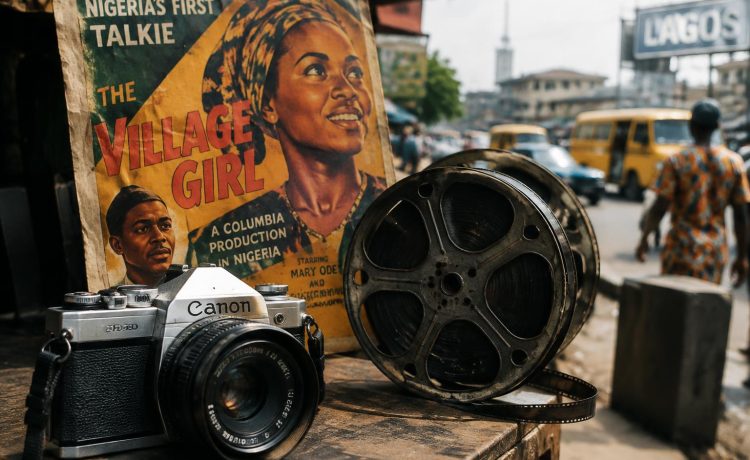
Ask who made Nigeria’s first movie, and the answer depends on what counts as a Nigerian film: a production made in Nigeria, a story set there, or a feature directed by a Nigerian. You will encounter competing milestones because early cinema developed under colonial rule, while Nigerian-led feature filmmaking took shape later with Ola Balogun’s Alpha (1972).
Defining Nigeria’s First Movie
Calling a film “first” depends on the category and the milestone you mean. You might be asking about the earliest moving images recorded in Nigeria, the first locally made feature, or the first Nigerian production released to cinema audiences. Those distinctions matter because film history includes works made for different purposes and shown through different channels. A precise answer therefore starts by identifying the format and the event that qualifies as its debut.
Feature films, documentaries, and early screen recordings
For a feature film, you generally mean a sustained, scripted narrative intended for theatrical exhibition, rather than any moving image produced in the country. Documentaries record real people or events, while early screen recordings may capture performances, ceremonies, or news without forming a conventional film. These categories can overlap in practice, but they are not interchangeable: a short documentary screened in Nigeria does not automatically count as the first Nigerian feature.
The importance of release dates and surviving records
Release history adds another distinction: a completed film is not necessarily a publicly released film. You need to separate production or completion dates from the first documented screening, which could occur at a cinema, festival, or private event. Records such as newspaper listings, cinema programmes, and censorship files can establish when and where an audience saw a work. Because some early records are incomplete, “first” may refer to the earliest verifiable release rather than the earliest film ever made.
The Pioneering Filmmaker and Production
To understand this early feature-film credit, you need to distinguish the filmmaker’s role from the production company’s contribution. Nigerian filmmaker Ola Balogun is commonly associated with the direction of Kongi’s Harvest, while Francis Oladele’s Calpenny Nigeria Ltd. was central to its production. Their collaboration linked local filmmaking expertise with a production mounted in Nigeria, placing the film among the country’s earliest feature-length productions.
Ola Balogun and early Nigerian filmmaking
As a filmmaker working across cinema and theatre, Ola Balogun helped shape Nigeria’s early feature production through his work as a director and screenwriter. You can trace his importance not to a single credit alone, but to his role in establishing locally directed feature filmmaking at a time when the industry was still developing. His association with Kongi’s Harvest remains a key part of that record, alongside films he directed later in the decade.
Production of Kongi’s Harvest
Calpenny Nigeria Ltd., the production company founded by Francis Oladele, produced Kongi’s Harvest with Ola Balogun directing. You can see the production’s Nigerian foundation in its local company and filmmaking leadership, although the project also drew on international theatrical connections. The film adapted Wole Soyinka’s play, and Soyinka’s involvement tied the production to the stage work that had premiered in 1965.
Kongi’s Harvest: The Film and Its Release
As a feature built around a political drama, Kongi’s Harvest brought Nigerian theatrical writing to the screen through a production made in 1970 and released in 1972. You encounter a film shaped by its source material and by the practical demands of adapting a stage play for cinema, with performance, setting, and visual composition carrying the conflict beyond the theatre. Its release marked an early milestone in Nigerian feature filmmaking.
Adaptation of Wole Soyinka’s play
Wole Soyinka adapted his own play for the screen, preserving its central confrontation between President Kongi and the traditional ruler, Oba Danlola. As you follow Kongi’s effort to consolidate power, the film sets political authority against inherited custom and ritual. The adaptation translates Soyinka’s theatrical dialogue and staged ceremony into cinematic scenes, with actors including Wole Soyinka as Kongi and Orlando Martins as Danlola grounding the struggle in sharply opposed performances.
Release history and significance as an early Nigerian feature
Released in 1972, Kongi’s Harvest is often identified as the first feature film produced in Nigeria after independence, though claims about Nigeria’s “first movie” depend on how production and national cinema are defined. You can place its release within the early development of locally made feature films, rather than treat it as the beginning of all filmmaking in the country. Its Nigerian production and feature-length form made the film a prominent early landmark.
The First Movie Question in Historical Context
To place Kongi’s Harvest in context, you need to distinguish a Nigerian production from films made in Nigeria or screened for Nigerian audiences. The film, adapted from Wole Soyinka’s play and directed by Ossie Davis, involved Nigerian artists and institutions while drawing on international production resources. Its significance lies in this overlap: Nigerian participation in cinema was expanding, but local production had not yet become a consistent, self-sustaining industry.
Colonial-era filmmaking and Nigerian participation
During the colonial period, you encounter filmmaking shaped largely by British administrators, commercial exhibitors, and production units such as the Colonial Film Unit. These bodies made films for education and public information, while Nigerian participation included acting, technical work, and audiences at screenings. Production authority and equipment remained concentrated outside local control, so Nigerian involvement did not automatically mean Nigerian ownership. That distinction matters when you assess early films made within the country.
The growth of indigenous film production
As Nigerian theatre and cultural institutions developed, you see stronger foundations for locally driven filmmaking, including the adaptation of Nigerian writing for the screen. Kongi’s Harvest drew on Soyinka’s play and brought Nigerian performers and creative material into a feature production, though its director and financing reflected international collaboration. The film therefore marks a developing stage rather than a mature national industry, with its Nigerian source text anchoring the production in local cultural life.
From Early Features to Nollywood
After the first wave of Nigerian features, cinema developed through changing production methods, distribution networks, and audience habits. You can trace that shift from films made for theatrical exhibition to productions designed for home viewing, then to a film industry with a strong presence across Africa and beyond. Each stage changed who could finance a film, how audiences encountered it, and how Nigerian stories circulated, from cinema halls to video shops and international screens.
The rise of home-video filmmaking
Home-video production expanded during the 1990s as filmmakers turned to affordable video cameras and cassette distribution rather than relying on costly celluloid and limited cinema access. You could find films sold or rented through local video shops, where direct-to-video releases reached viewers across Nigeria. Producers often worked quickly with compact crews, shooting stories in homes, offices, and streets, then editing for release on VHS. The format brought production closer to everyday audiences.
Nollywood’s emergence and international reach
Nollywood took shape as this steady output developed into a recognizable industry, supported by producers, actors, directors, marketers, and distributors. You encounter its films in English and Nigerian languages, with stories shaped by urban life, family relationships, religion, comedy, and crime. Distribution now extends beyond physical video sales to television, streaming platforms, and diaspora audiences. Nigerian productions circulate internationally while retaining settings and dialogue grounded in places such as Lagos, Enugu, and Benin City.
Other Milestones in Nigerian Cinema
You encounter several different milestones in Nigerian film history because filmmakers worked in distinct languages, formats, and production settings. A feature-length theatrical release, a film made in a Nigerian language, and a production led by a Nigerian filmmaker describe separate achievements, not interchangeable definitions of “first.” Keeping those distinctions clear lets you recognize the contributions of early productions without treating one category as the sole measure of the country’s cinematic beginnings.
Amadi and early films in Nigerian languages
With Amadi, you see an early feature associated with Nigerian-language filmmaking, rather than a claim that displaces other milestones. Directed by A. A. Nwankwo and released in 1975, the film was made in Igbo and reflects a period when local-language productions reached cinema audiences. Its significance lies partly in that language choice, which connects screen storytelling with the speech and cultural setting familiar to Igbo-speaking viewers.
Different claims based on format, language, and production history
When you assess competing “first” claims, identify what each one measures. A film shot on celluloid and screened in cinemas belongs to a different format history from a television drama or a video-film release. Language also changes the category: an English-language feature does not establish the first Nigerian-language production. Production records, including director, financing, and release context, further shape the claim, so each milestone needs its own precise description.
To wrap up
You can trace the answer to Nigeria’s first feature film to Palaver, directed by Geoffrey Barkas and filmed in Nigeria in 1926, while recognizing that later milestones refer to different kinds of “first.” For a landmark in Nigerian-produced cinema, you can point to Kongi’s Harvest, directed by Ossie Davis and released in 1970. Keeping these distinctions clear places each film in its proper history, from colonial-era production to the features that shaped Nigerian cinema.
