
Madam Flow, a new Nigerian coming-of-age film about periods and puberty in a boarding school, offers directors a model for handling a sensitive subject with a young cast.
The film has wrapped and is in post-production, and it has not yet been released. That makes it unusual to write about: nobody outside a private screening has seen it. What we do have is a set of published interviews and statements from its director, Orobosa Ikponmwen, and its producers. Read together, they set out a clear way of making a film about a subject that many schools and families still avoid. This guide sets out what is confirmed about the film, why the subject is hard to put on screen, and what other filmmakers can take from the approach.
Prefer to watch? The companion video on The Hidden Ledger walks through the four choices with original diagrams:
Madam Flow: what is confirmed so far
Madam Flow is produced by Kinsman Studios, a Lagos-based production company, with support from Africa No Filter. According to What Kept Me Up, which published the first look on 19 October 2026, the film is written by Ololade Okedare and Ayobola Eniola, who also produce it. Orobosa Ikponmwen directs, with Eniola as co-director. Galaxy TV and Broadcast Media Africa report the same team.
The story is set in a conservative Nigerian boarding school. Its lead is an inquisitive 13-year-old, played by Pamilerin Ayodeji, who wants to understand periods and puberty after her best friend gets her first period. Her questions spark a secret rebellion among the students, in a school culture that, in What Kept Me Up’s words, is “more inclined to punish her questions than answer them”.
- Cast: Pamilerin Ayodeji, Darasimi Nadi (the best friend), Tina Mba, Fiyin Asenuga, Sharon Rotimi, Scarlet Gomez and Michael Ejoor.
- Status: principal photography complete; in post-production.
- Release: no release date, distributor or platform announced. An invitation from Kinsman Studios listed a private screening at Silverbird Galleria, Lagos, on 25 November 2026, during the Kingdom Film Festival.
Ayodeji is not new to festival audiences. What Kept Me Up notes that she broke out in Akinola Davies Jr.’s Sundance-winning short Lizard and has since appeared in Mikolo and Gangs of Lagos.
Why period stigma is hard to put on screen
The difficulty is not only that menstruation is a private subject. It is that silence is part of the problem the film describes. UNICEF Nigeria says the taboos and stigma attached to menstruation lead to a culture of silence, which limits the information girls receive and affects their health and dignity.
Schools can add to the pressure. A small qualitative study published in the Pan African Medical Journal in 2023 interviewed 20 girls in rural and semi-urban secondary schools in Enugu State. Nineteen said they had felt embarrassed and ashamed as a result of menstruation, and nineteen said they had missed school in the previous six months because of it. Participants pointed to strict rule enforcement and to uniforms and activities planned without regard to menstruation. It is a small sample, not a national figure, but it describes exactly the kind of institution Madam Flow puts at the centre of its story.
For a director, that creates three risks at once:
- Shame: the film reproduces the embarrassment it wants to challenge.
- Lecture: the story turns into a health lesson and loses its audience.
- Exposure: young performers are asked to carry a subject they have not been prepared for.
How Orobosa Ikponmwen describes her approach
In an interview with The Nollywood Reporter, summarised by Galaxy TV and Mad TV on 1 November 2026, Ikponmwen explained what drew her to the story and how the team prepared it.
She starts from the child’s curiosity
Ikponmwen said she was drawn to the protagonist’s determination to find solutions to issues that matter to her, in a society that often discourages children from asking questions. Describing how young people who challenge established attitudes can be treated, she said: “You become a problem.” Mad TV adds that she sees some of herself in the character.
What Kept Me Up observes that early adolescence is still comparatively uncommon as the driving perspective of Nigerian feature films. Choosing that perspective is itself a directing decision: the audience learns at the same pace as a 13-year-old, so information arrives through questions rather than explanation.
She treats rebellion as something that can be good
“Rebellion isn’t inherently bad,” Ikponmwen said, arguing that constructive challenges to established practice can drive social change. She also stressed that such energy needs to be pointed at causes worth the cost. That framing matters for tone. A story about a “secret rebellion” of curious schoolgirls invites warmth and humour, which What Kept Me Up signals when it calls the lead “hilariously inquisitive”.
She is speaking to adults as well as children
Ikponmwen said some body-image challenges experienced by adults can be traced to how they were taught, or not taught, about their bodies as children, and she hopes the film encourages adults to reconsider how they respond to children’s curiosity. In other words, the film has two audiences: young viewers who may recognise their own questions, and parents, teachers and carers who are being asked to answer them.
She brought the cast into the process
According to both reports, the production began with discussions and a group script reading in which cast members shared their thoughts and personal experiences, and this helped shape the story. Mad TV reports that the cast kept asking questions before and during filming, and that the directors welcomed this. The filmmakers also spoke with young people who attend, or once attended, boarding school, so that the setting would feel familiar to audiences.
What filmmakers can take from Madam Flow
You do not need to be making a film about menstruation to use these ideas. Any sensitive subject, whether grief, abuse, illness, faith or sexuality, raises the same questions. Here is a practical way to apply them.
1. Decide whose eyes the audience will use
Write down, before the shot list, whose point of view drives each scene. If it is a child’s, let information arrive as questions. On set that can mean keeping the camera at the child’s eye height, letting adults who refuse to answer sit partly out of frame, and staying on the child’s reaction rather than on the explanation. These are general techniques, not a description of Madam Flow’s shots, but they turn a perspective decision into something the crew can execute.
2. Set a tone that keeps people in the room
A grim register can make an audience defensive. Humour and warmth can do the opposite, provided the joke lands in the right place. A useful rule for writers: the comedy should come from the gap between what the children want to know and what the adults will say out loud. The laugh should be at the silence, never at the girl.
3. Research with the people who live that world
Madam Flow’s team spoke with current and former boarding-school students. That is research for authenticity, not just accuracy: uniforms, rules, slang and routines are what make a young viewer trust a film. A simple script-stage test is to show a scene to a teenager and to a parent and ask each what they would want to talk about afterwards.
4. Build care for young performers into the schedule
Ikponmwen’s description of an open read-through and welcomed questions matches what broadcasters’ safeguarding guidance asks for. The BBC’s guidance on working with children and young people says productions should make sure children and parents understand what is planned, keep checking that the young person remains comfortable, respect them if they change their mind (for example with an agreed hand signal), and provide a single, consistent point of contact for welfare. Its safeguarding advice for parents adds explaining what will happen and allowing questions. In a drama with adult themes, it says, crews should make sure strong language and action on set does not spill over off set.
That guidance is general and UK-based; it is not a description of the Madam Flow set, and local rules on child performers differ between countries. But in practice, three fixed points cover a lot of ground on any production:
- Pre-production: a read-through where young actors can ask anything.
- The day before: a plain-language explanation of each sensitive scene, for the young performer and their guardian.
- Every day: a named welfare contact who is not the director.
Why this matters for Nollywood
Nollywood has a long record of social-issue storytelling (see our look at how Citation examined social issues). What stands out about Madam Flow is the combination of a subject that is rarely discussed openly, a child’s point of view, and a production process designed around listening to its young cast. It sits alongside other recent conversations about care on set, such as the safety planning described by Olive Nwosu in our breakdown of how she directed LADY.
For parents and young actors approaching the industry, the same principles apply from the very first audition: our guide to finding legitimate Nollywood auditions and casting calls is a useful starting point.
Final thoughts
Madam Flow has not yet been released, so its success on screen cannot be judged. Its director’s stated approach, though, offers a usable model for any filmmaker taking on a sensitive story: choose the perspective deliberately, let tone invite conversation rather than shut it down, research with the people whose world you are showing, and make it safe for young performers to ask questions. We will update readers when Kinsman Studios announces release plans.
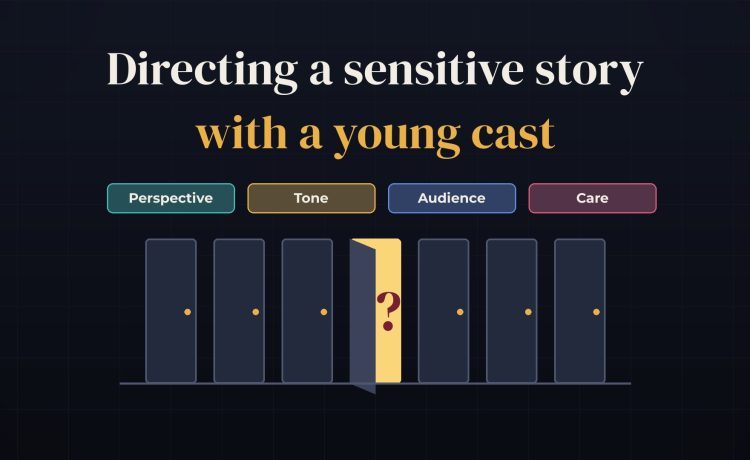
Featured image: original graphic.
